Civil Society · Research · Education

Building equitable, efficient and inclusive institutions for Pakistan.

Sabir Global Society advances the EEEQI Framework — Equality, Efficiency, Effectiveness, Quality and Inclusiveness — to strengthen the justice system and the education system, in line with the UN 2030 Agenda (SDG 4 & SDG 16).

13NOV One-Day Workshop on the EEEQI Framework Quaid-e-Azam Law College, Lahore · Friday, 13 November 2026
Sabir Global Society logo — Equity, Efficiency, Effectiveness, Quality, Inclusiveness (EEEQI)
  • Equality
  • Efficiency
  • Effectiveness
  • Quality
  • Inclusiveness
2.2M+Pending cases in Pakistan's courts
26M+Out-of-school children to bring into education
<2%of GDP spent on education today — target 4–6% by 2030
5Guiding principles — one framework for every institution

About SGS

A research and educational society for institutional reform.

Sabir Global Society (SGS) is a civil society research and educational organization registered in Pakistan. We are committed to promoting institutional governance, legal systems reform, equality, efficiency and academic engagement across the country.

Our EEEQI principles offer a framework for strengthening educational and legal institutions, improving governance, ensuring equitable opportunities and enhancing public services. We give particular attention to constitutional rights, access to justice, accountability and inclusive institutional practices.

Dr. Mumtaz Muhammad Khan Chairman & Founder, Sabir Global Society

Research & Frameworks

Developing the EEEQI Framework as an operational blueprint for policy and institutional implementation.

Workshops & Training

Academic workshops for instructors and students, with curricula, reading packs and expert resource persons.

Competitions & Conferences

Poster competitions and national conferences that bring scholars, students and policymakers together.

Institutional Partnerships

Formal collaborations with law colleges and universities to take academic dialogue into practice.

The EEEQI Framework

Five principles. Two systems. One blueprint.

SDG 4 and SDG 16 define the global outcomes. EEEQI provides the operational blueprint for reaching them — applied here to Pakistan's judiciary and its education system.
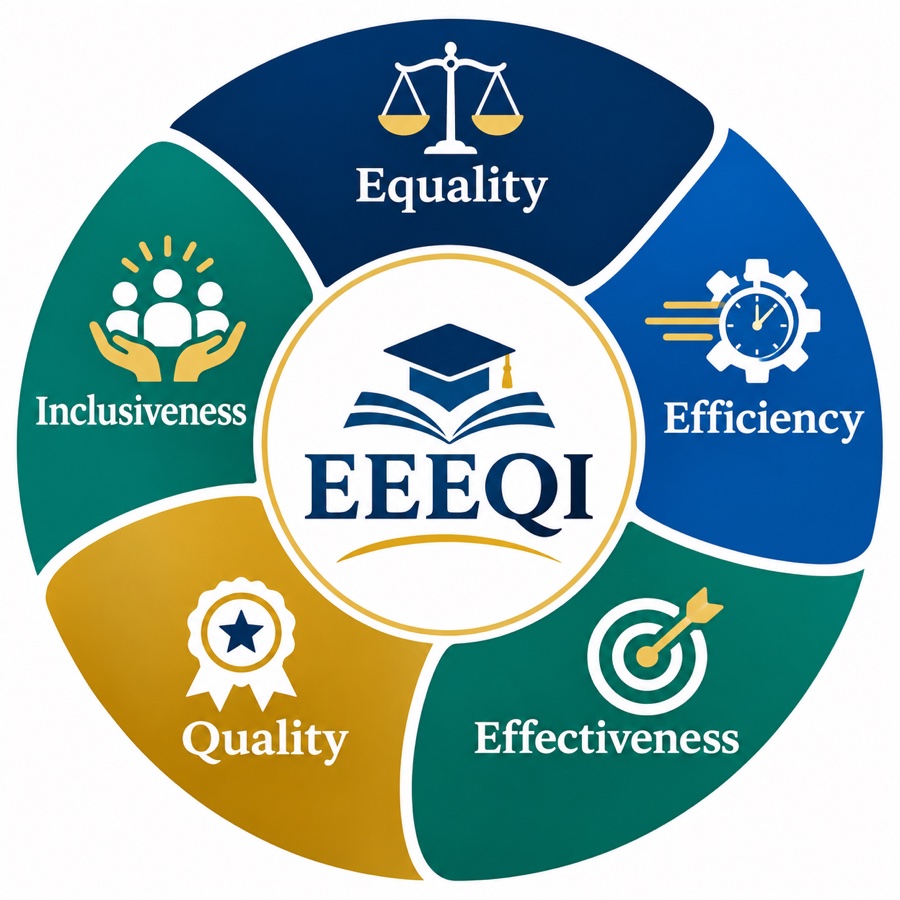
EEEQI wheel: Equality, Efficiency, Effectiveness, Quality, Inclusiveness

Justice & Constitution · SDG 16

Judicial foundations under the 1973 Constitution

The constitutional architecture through which EEEQI-driven reform of Pakistan's judiciary takes place.

Part VII · Article 175

Judicial Hierarchy

Establishes the Supreme Court of Pakistan, High Courts in each province, and subordinate judiciaries operating under law.

18th Amendment · Article 175A

Judicial Commission

Standardizes transparent, merit-based appointments for judges of superior courts via the Judicial Commission of Pakistan.

Articles 184(3) & 199

Writ Jurisdiction

Empowers the Supreme Court and High Courts to enforce fundamental rights and issue constitutional remedies against state actions.

Chapter 3A · Articles 203A–J

Federal Shariat Court

Examines whether existing laws comply with Islamic principles and the injunctions of the Quran and Sunnah.

Article 175(3)

Separation of Powers

Mandates the complete independence of the judiciary from the executive to ensure impartial administration of justice.

Article 4 Guarantee

“To enjoy the protection of law and to be treated in accordance with law is the inalienable right of every citizen.”

SDG 16 Peace, Justice & Strong Institutions

Promote peaceful and inclusive societies for sustainable development, provide access to justice for all, and build effective, accountable institutions at all levels.

How the Constitution aligns with SDG 16

Equal Access to Justice for All Articles 4 & 37(d)

Inalienable protection of law (Art. 4) and inexpensive, expeditious justice for all citizens (Art. 37d).

Protection of Life & Liberty Articles 9 & 10A

Right to life and personal liberty (Art. 9) and the guarantee of a fair trial and due process (Art. 10A).

Institutional Transparency & Information Article 19A

Right to Information in all matters of public importance, advancing institutional accountability.

Strong & Independent Institutions Article 175(3)

Separation of the judiciary from the executive to ensure institutional integrity and the rule of law.

SDG 16 Targets12 targets for peace, justice and strong institutions
  1. 16.1Significantly reduce all forms of violence and related death rates everywhere.
  2. 16.2End abuse, exploitation, trafficking and all forms of violence against and torture of children.
  3. 16.3Promote the rule of law at the national and international levels and ensure equal access to justice for all.
  4. 16.4By 2030, significantly reduce illicit financial and arms flows, strengthen the recovery and return of stolen assets, and combat all forms of organized crime.
  5. 16.5Substantially reduce corruption and bribery in all their forms.
  6. 16.6Develop effective, accountable and transparent institutions at all levels.
  7. 16.7Ensure responsive, inclusive, participatory and representative decision-making at all levels.
  8. 16.8Broaden and strengthen the participation of developing countries in the institutions of global governance.
  9. 16.9By 2030, provide legal identity for all, including birth registration.
  10. 16.10Ensure public access to information and protect fundamental freedoms, in accordance with national legislation and international agreements.
  11. 16.aStrengthen relevant national institutions, including through international cooperation, to prevent violence and combat terrorism and crime.
  12. 16.bPromote and enforce non-discriminatory laws and policies for sustainable development.

Selected measurement indicators (UNODC)

  • 16.1.1 Victims of intentional homicide per 100,000 population, by sex and age
  • 16.1.4 Proportion of population that feel safe walking alone around their area
  • 16.3.1 Victims of violence who reported their victimization to competent authorities
  • 16.3.2 Unsentenced detainees as a proportion of the overall prison population
  • 16.5.1 Persons who paid, or were asked for, a bribe by a public official in the previous 12 months

Education · SDG 4

The right to quality education

“Ensure inclusive and equitable quality education and promote lifelong learning opportunities for all.” — SDG 4

Education in the Constitution of Pakistan, 1973

Art. 25-A · 18th Amendment

Right to Education

The State shall provide free and compulsory education to all children aged 5 to 16, as determined by law.

Article 22

Religious Safeguards

No one may be compelled to receive religious instruction or attend ceremonies of a religion other than their own.

Article 26

Non-discrimination

Non-discriminatory access to public educational institutions regardless of race, religion, caste or place of birth.

Article 28

Language & Culture

Every section of citizens may preserve and promote its distinct language, script and culture.

Article 37(a) & (b)

Social Justice & Illiteracy

Promote the educational interests of backward areas, eradicate illiteracy and provide free secondary education in minimum time.

Articles 37(c) & 38(d)

Technical Access & Merit

Make technical and professional education generally available, based solely on merit.

18th Amendment Impact

Provincial Devolution

Abolition of the Concurrent List (2010) transferred curriculum, policy and standards to the provinces.

Judicial Enforcement

Right to Life Link

Superior courts enforce Art. 25-A through constitutional writs, treating basic education as part of the Right to Life (Art. 9).

SDG 4 targets & indicators

Roadmap: transforming Pakistan's education system for SDG 4

Pillar 1

Universal Access, Inclusion & Out-of-School Children

  • Alternative learning pathways — afternoon shifts, non-formal centres and community schools for 26M+ OOSC (Target 4.1)
  • Targeted inclusion incentives — stipends for girls, sanitation, safe transport and accessible infrastructure (Target 4.5)
  • Universal ECE — early childhood classrooms in all primary schools (Target 4.2)
  • Enforcing Article 25-A — provincial education acts backed by budget allocations and legal enforcement

Pillar 2

Learning Poverty, Digital Integration & Teacher Capacity

  • Foundational literacy & numeracy — mother-tongue foundation, daily reading hours, minimum learning benchmarks in Grades 1–5
  • Teacher professionalization — licensing, CPD, merit-based recruitment, digital competency (Target 4.c)
  • EdTech & infrastructure — solar energy, connectivity, computer labs and blended tools (Targets 4.4 & 4.a)

Pillar 3

Governance, Skills & Higher Education Alignment

  • Market-driven TVET — vocational training integrated into secondary schools (Target 4.3)
  • Research & STEM — 4-year BS with industry capstones, incubation and HEC research funding
  • Data-driven management — EMIS/PIE systems tracking learning outcomes and resources in real time

Target funding goal

Raise national education spending from under 2% of GDP toward the SDG 4 benchmark of 4–6% by 2030.

Events & Programmes

2026–27 academic programme

A workshop, a poster competition and a national conference, organized jointly with Quaid-e-Azam Law College, Lahore.

Upcoming

One-Day Workshop on the EEEQI Framework for Instructors & Students

An academic dialogue on Equality, Efficiency and Inclusiveness in Pakistan's legal system — for legal scholars, academics, researchers, policymakers, students and civil society representatives.

  • Friday, 13 November 2026
  • 120 minutes, including a 28-minute tea break
  • Quaid-e-Azam Law College, Model Town, Lahore

Programme

  1. Inaugural session10 min
  2. Thematic presentations45 min
  3. Tea break28 min
  4. Question & answer session15 min
  5. Way forward10 min
  6. Conclusion5 min
  7. Certificates to participants5 min
  8. Certificates to active participants — 1st, 2nd & 3rd2 min
  1. 13 Nov 2026

    EEEQI Workshop

    Thematic presentations, Q&A and way-forward discussion with certificates for participants.

  2. December 2026

    Poster Competition

    Students present EEEQI-based ideas for reforming legal and educational institutions.

  3. January 2027

    National Conference

    A national platform for scholars and policymakers, with jointly published proceedings.

Partnership

Memorandum of Understanding with Quaid-e-Azam Law College, Lahore

Signed 3 November 2026, for an initial term of one year. SGS and QLC jointly organize academic workshops and initiatives on the EEEQI Framework, with the right to jointly publish reports, proceedings and outcomes.

Dr. Mumtaz Muhammad KhanChairman & Founder, SGS
Ch. Muhammad SaleemChairman, Quaid-e-Azam Law College

Sabir Global Society

  • Workshop materials, reading packs & curriculum
  • Speakers, facilitators, trainers & moderators
  • Media, PR & social media coverage
  • Registration & transparent financial handling
  • Programme execution

QLCQuaid-e-Azam Law College

  • Venue with audio-visual facilities
  • Refreshments for guests & participants
  • Flexes, banners & backdrops
  • Printing of certificates
  • Faculty & student participation

Get Involved

Register, partner or get in touch

Register for the workshop, propose a collaboration with your institution, or ask about our programmes. Your message goes straight to the SGS office on WhatsApp.

  • Dr. Mumtaz Muhammad KhanChairman & Founder
  • 0321-4577773Phone / WhatsApp
  • Lahore, PakistanRegistered office